


Toby Moore: “The Greek Market Is Increasingly Influential in the Superyacht Sector” | The Future of Monaco Yacht Show


In an exclusive interview with Boating Greece, Toby Moore, CEO of Informa Prestige, discusses the evolution of Monaco Yacht Show, the changing profile of superyacht buyers, sustainability, innovation and the extraordinary logistics behind one of the world's leading yachting events.
“Given that Southern Europeans, and the Greek market in particular, are increasingly influential in the superyacht sector, our relationship with your region is more vital than ever. The Monaco Yacht Show (MYS) remains a unique crossroads for the Mediterranean fleet, and I am happy to share how we prepare for this global rendezvous.”
With these words, Toby Moore highlights the growing importance of the Greek and wider Mediterranean markets to Monaco Yacht Show. As the superyacht industry undergoes significant changes, from the profile and expectations of yacht buyers to technological innovation and environmental responsibility, the event continues to evolve beyond its traditional role as a showcase for exceptional vessels.
In this conversation with Boating Greece, Moore discusses the strategic direction of Monaco Yacht Show, the changing expectations of a new generation of owners, the industry's approach to sustainability and the remarkable operational effort required to transform Port Hercule into one of the most important meeting points on the international superyacht calendar.
1. Monaco Yacht Show continues to attract the world's leading superyachts and brands. How do you keep the event fresh and relevant year after year?
The secret to MYS's longevity is that we are no longer just an exhibition of vessels; we have evolved into a holistic ecosystem and a hub of intelligence.
We keep the show relevant by acting as a “live decryptor of the luxury mindset”, carefully curating a fleet of 120 superyachts that includes nearly 50 world premieres every year. Missing even a single edition means missing a unique snapshot of the market that will never be replicated.
Beyond the docks, we stay ahead of a rejuvenated market where the average age of buyers has dropped from 60 to closer to 50. These younger, digitally native clients demand more than status symbols; they seek experiential yachting and technical transparency.
To meet this, we have introduced thematic areas such as the Adventure Area for off-grid exploration and the Yacht Design & Innovation Hub, which we are completely resetting for 2026 to offer immersive, dialogue-driven interactions rather than static displays.
2. Sustainability is becoming a key focus across the industry. How is Monaco Yacht Show helping drive that conversation forward?
We have chosen rigour over rhetoric.
Through our institutional programme, Blue Wake™, we are moving the industry away from marketing claims and towards independent technical validation. Developed with the Water Revolution Foundation, every solution featured in this programme must provide documented evidence, such as YETI (Yacht Environmental Transparency Index) scores or lifecycle assessments.
For the 2026 edition, we are driving this conversation even further by expanding Blue Wake™ to include the brokerage and yacht management sectors.
This acknowledges that sustainability is a lifecycle commitment. It does not end when the yacht leaves the shipyard; it continues through every fuel choice, charter season and operational decision.
By making these metrics legible to owners, we are establishing technical transparency as the new standard of excellence in yachting.
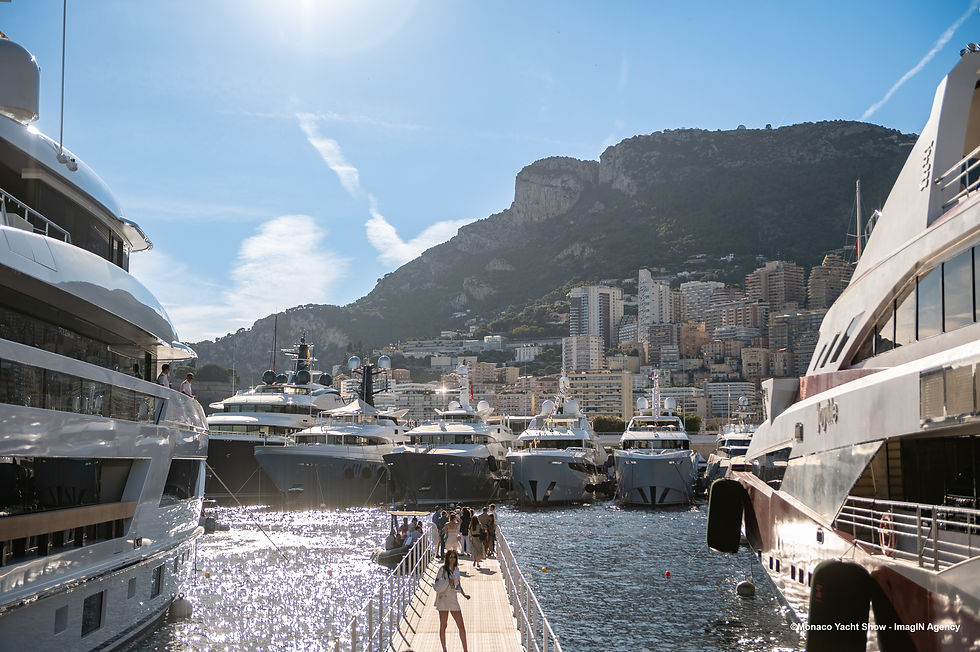
of organising Monaco Yacht Show each year?
What many visitors never see is the colossal logistical scope required to transform Port Hercule.
We have a core team of only 20 people working year-round, spending 95% of their time on AutoCAD and Excel to define processes that must be executed with millimetre precision.
The most challenging aspect is transforming a “pocket handkerchief” space in one of the world's smallest countries into a 16,000 m² temporary village in under 25 days.
We must coordinate 450 trucks and position 180 units, yachts and tenders, with absolute precision while ensuring the Principality remains functional for its residents.
We occupy the port for exactly 40 days, and there is absolutely no margin for error. It is a high-pressure environment where we have reached the logistical limits of what is possible in an urban setting, yet that very constraint is what pushes us to deliver an experience that feels fluid and effortless for our guests.


